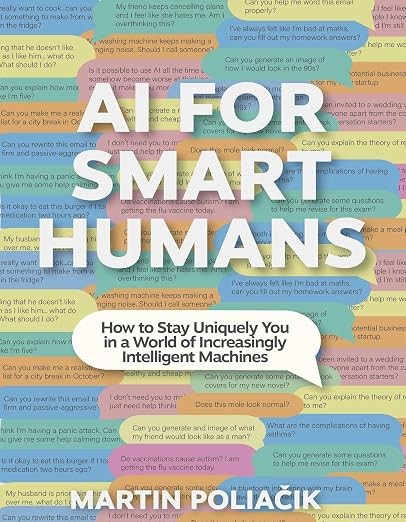
AI for Smart Humans
How to Stay Uniquely You in a World of Increasingly Intelligent Machines
This book is your ticket to the AI age. Discover dozens of ways to turn your experience, knowledge and thinking patterns into genuine collaborative fluency, told through stories, real-life examples and lively language. Boredom not included.
Already have the book? Find your chapter and the extra material.
I wrote this book with substantial help from ChatGPT and Claude. The choices, and the responsibility for them, remain mine.
- Publisher
- Black Spring Press, London
Preorder from your bookshop





Hardcover, published by Black Spring Press. The links lead to each shop's own page for the book.
What happens to your thinking?
- Start with your own thinking.
- Find the gaps between your understanding and AI’s.
- Build arguments you can explain and defend.
- Use CompensAItion to choose which abilities you want to keep practising.
What the book explores
A machine can hand you a polished argument before you have quite worked out what you believe. Useful, certainly. Also a good moment to pause.
AI for Smart Humans brings over thirty years of teaching critical thinking and communication into the conversation with AI. We begin with your own rough sketch, make hidden assumptions visible and learn to build explanations another person can follow. Along the way, we ask which parts of our thinking we want to keep in practice.
You can welcome a better idea from a machine and still remain the author of the result. The skill is understanding what you are choosing and why.
I wrote the book with substantial help from ChatGPT and Claude. That collaboration, including its awkward moments, is part of the story.
The machines are getting better at answering. This book helps you become more deliberate about the questions, the collaboration and the work you choose to call your own.
This book brings those thinking tools into everyday work with AI. You will find stories, exercises and questions worth keeping nearby when an answer looks so convincing that you almost forget to examine it.
Choose your way in
Read from the beginning or follow a question. The chapter icons help you find your route.
Philosopher
Follow the questions about meaning, identity, ethics and the futures we might create.
Mind Hacker
Explore mental habits, motivation and what happens to thinking when AI joins in.
Professional
Find tools for clearer communication, stronger arguments and decisions you can explain.
Educator
Explore curiosity, purposeful practice and how to tell whether learning is happening.
Ways through the book
Some readers begin at page one. Others open a book somewhere in the middle and follow whatever catches their attention. I have made room for both. Chapter icons help you find the questions that interest you most.
21 chapters in six parts
Part 1
Introduction
Part 2
Framework
Part 3
Hybrid Intelligence Techniques
Part 4
Hybrid Intelligence Tools
Part 5
CompensAItion
Part 6
Message for Troubled Times
What early readers say
“The real challenge is no longer learning how to use the tools, but learning how to think alongside them.”
“A very original and unusual handbook about the use of AI: the ‘thinking about thinking’ man’s guide to living advantageously with AI.”
“Practical, engaging and thought-provoking, this book reminds us that technology is at its most valuable when it expands human capability rather than substitutes for it.”
“This book will help you not only to be better at working with AI; it will also make you a better thinker.”