Hybrid Mapping
Compare your map of a problem with AI’s. Investigate the differences.
Exercise: Two maps of one problem
Time: About 20 minutes
- Pick a problem you know well with at least four parts that influence one another.
- Draw boxes for the parts and arrows for their relationships. Label what each arrow means.
- Describe the situation to AI in a few sentences. Use the first prompt below.
- Compare the maps yourself, or use the second prompt to help. Check that any claimed difference is actually present.
- Write down one question the comparison raised that you would not otherwise have asked.
How it works
- Choose a situation with several connected parts.
- Draw or write your own map.
- Give AI a description of the situation and ask for its map before showing yours.
- Compare the elements and connections. Turn the differences into questions.
Things to watch
- Showing your map first may encourage AI to mirror it. Keep the first attempts separate when you want a comparison of perspectives.
- A tidy diagram can still contain a poor causal claim.
- Look beyond “they seem similar”. Examine what each map makes easier to see or easier to miss.
Example from the book
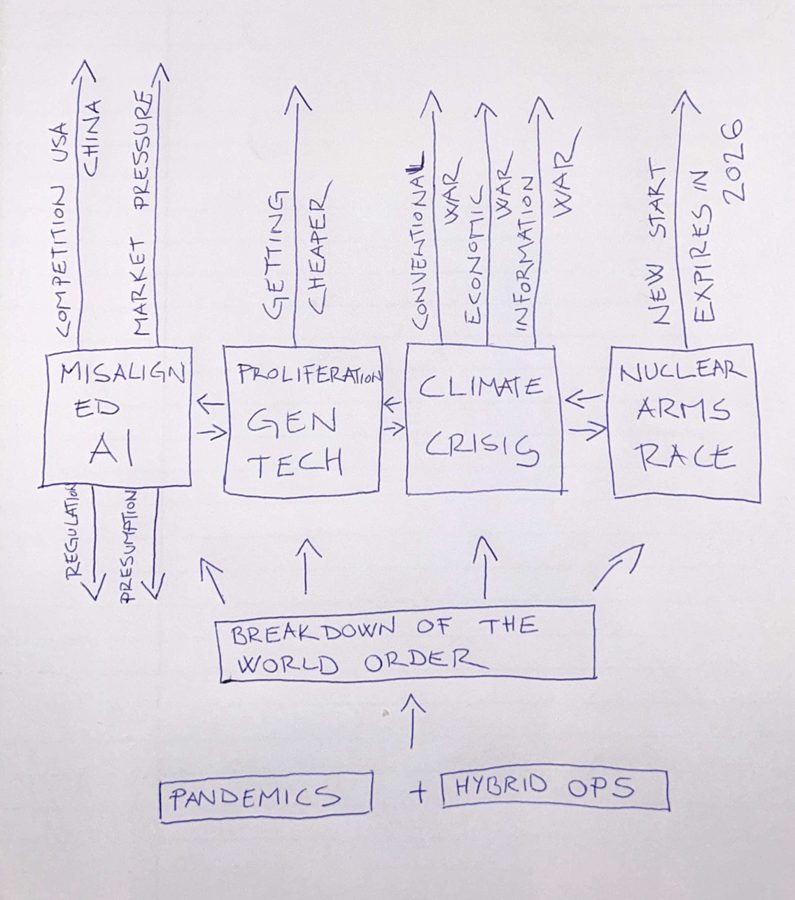
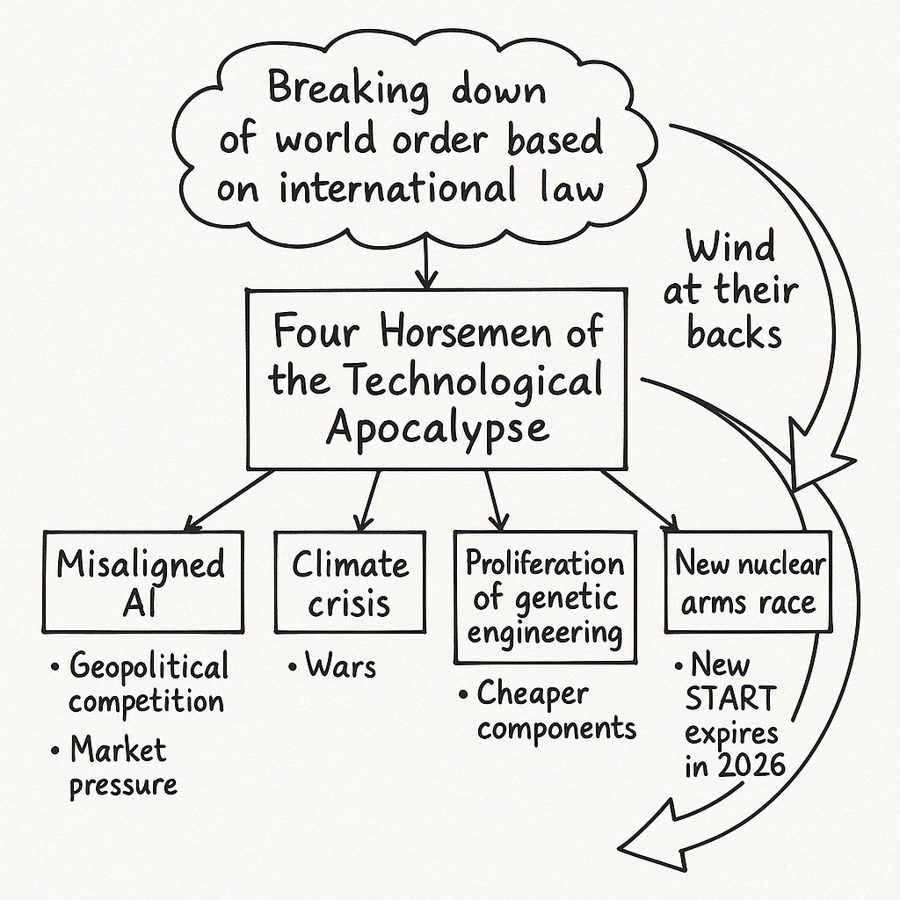
In March 2025, I mapped how several global risks might feed one another and asked Sage for his version. Comparing them revealed different groupings and a mistake in Sage’s account of the maps. I kept the mistake in the book. The comparison needs checking too.
Optional ways to involve AI
Use these examples as a starting point. Replace the square-bracketed fields with your own material.
Make an independent map
Create a structured map of the situation below. List the main elements, then show the relationships as “A → B: how A influences B”. Distinguish information I supplied from assumptions you add. Mark uncertain connections. Leave recommendations for later.

SITUATION:
[Describe it in three to five sentences.]
Compare our maps
Here is my map of the same situation. Compare it with the map you produced. List:
1. Elements and links both maps contain.
2. What appears only in my map.
3. What appears only in yours.
4. Three questions raised by the differences.

Point to the actual elements or links behind each comparison. Do not assume either map is correct.

MY MAP:
[Describe your boxes and arrows, or attach a legible image if the tool supports images.]
The thinking behind it
Two people can use the same words and picture different relationships. The same difficulty appears in an AI conversation. A map makes the structure available for inspection: what connects to what, which direction the influence runs and what has been left out.
Map a situation yourself, then ask AI to map it from a description. Compare the elements and connections. Where do the pictures differ, and why? A missing arrow can be more revealing than a page of fluent agreement.
Related
- Glossary: Shared mental model
More to try
Get a note when I add reader material.
The stories and context behind Hybrid Mapping are in chapter 7 of the book.
Preorder the book