SMI²LE! 2026
Turning On, Tuning In, Dropping Out in the Age of Algorithms
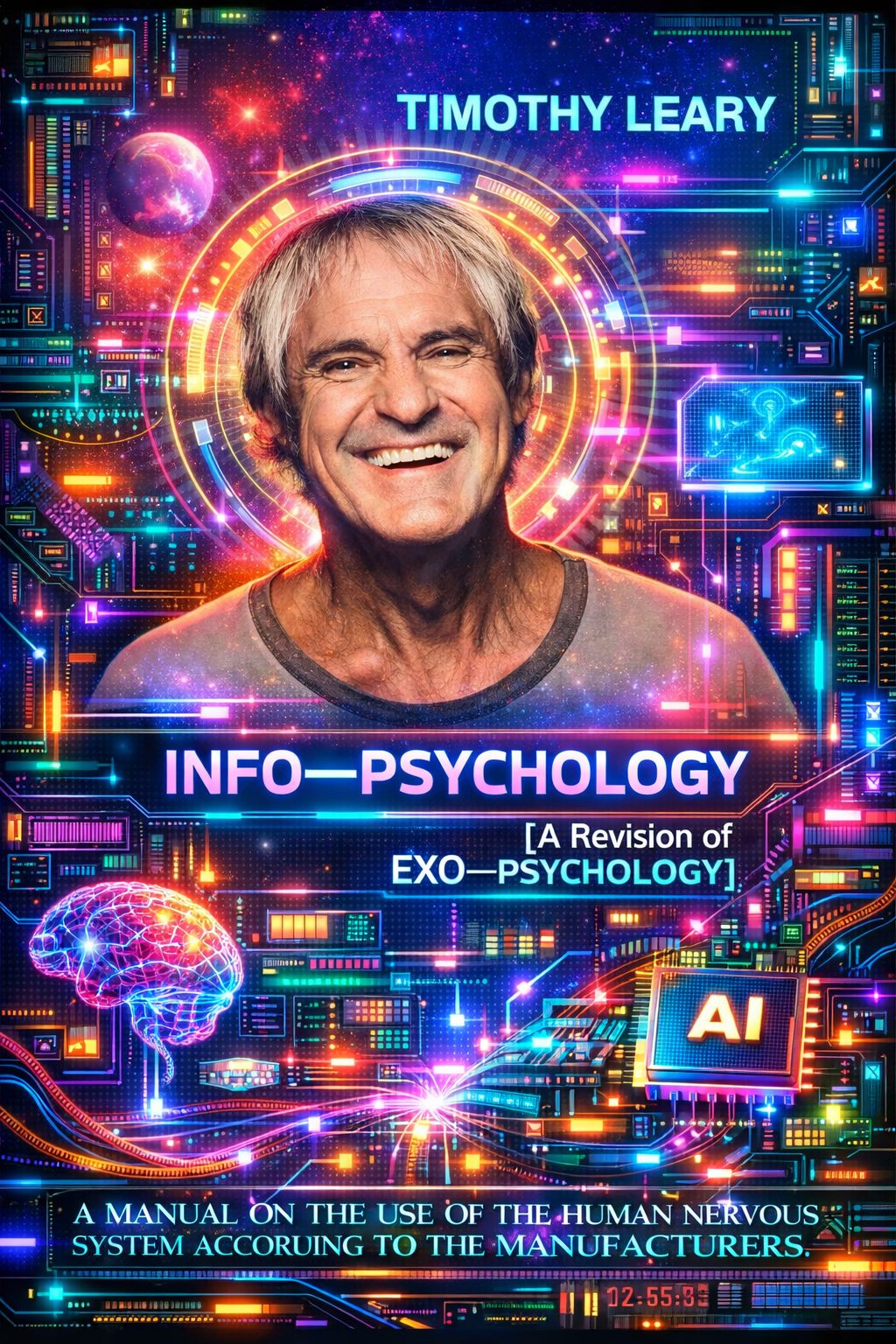
Many people say we should reread old futurist classics to see their echoes in today’s world. Some suggest Dune to understand Elon Musk’s space dreams, or Brave New World and 1984 for our tech-driven societies. I decided to pull a less obvious gem off the shelf: Timothy Leary’s Info-Psychology. In 1998, during my budding psychonaut days, I devoured this book’s mad theories about the future (in a freshly published Czech translation). Leary influenced me even then as a visionary. Now, decades later, I’ve returned to those pages to see how much he got right, and what else he imagined for our future.
The Eight-Circuit Map of Consciousness
Re-reading Info-Psychology today, I’m struck by the audacity and scope of Leary’s theory. The book is framed as a “manual for the human nervous system,” laying out a sweeping model of how our minds evolve both within a lifetime and across our species. Central to this model is the concept of imprinting: at key developmental stages, our brains stamp in patterns of perception and behavior that become our default reality. For example, the very first imprint (in infancy) sets our basic attitude toward the world - fundamental trust or fear. Once an imprint is set, it tends to last for life unless a powerful experience reconfigures it. In other words, much of what we consider “reality” is really the result of deep neural programs we never consciously chose. Each life stage activates a new layer of consciousness with its own imprint, and Leary organized these layers into an eight-circuit model of consciousness, a kind of staircase of psychological evolution.
While the eight circuits provide the broad architecture of Leary’s vision, he goes even deeper, mapping out a “Periodic Table of Evolution” that breaks these layers down into twenty-four specific stages. It’s a dizzying, fractal-like expansion of the same idea: each circuit is subdivided into a three-part developmental loop, starting with passive reception, moving through active integration, and ending in transmission, where the circuit becomes something you can express, share, or fuse into a larger system. The first twelve stages trace our long crawl from invertebrates and early marine life, through predator-mammalian and tribal eras, and into the high-industrial collective. The final twelve, however, are explicitly “Cyber-Quantum,” sketching a post-terrestrial trajectory in which we move from being consumers of technology to mastering the codes of our own biology and, in Leary’s most extreme speculations, even the sub-atomic fabric of reality. It’s as if he wasn’t content with building a staircase to the stars; he wanted to catalogue every individual step from “larval” robothood to something cosmic.
In simple terms, the first four circuits correspond to basic human survival and social development from infancy through adolescence. They cover our bio-survival instincts (safety and nourishment), emotional power dynamics (dominance and submission), symbolic intelligence (language and logic), and social-sexual roles (adapting to tribe or family norms). These are the “larval circuits,” the Earth-bound modes of being that form “normal” adult consciousness. By the time we’re grown, we’re essentially running on those four programs, caterpillar-like, as Leary would say, still short of what we could become.
The truly provocative part of Info-Psychology is what comes after those four familiar circuits. Leary believed there are four higher circuits – latent until triggered – which represent our post-terrestrial potential. These latter four are sometimes called the “stellar” or “cyber” circuits, and Leary saw them as the key to our future evolution. Circuit V, for instance, is the “neurosomatic” circuit (or cyber-somatic), which he described as a blissful bodily awareness—a state of hedonic serenity where one can re-tune the senses and experience the body and mind in ecstasy, free of cultural hang-ups. People momentarily touch this state during peak experiences, through yoga, Tantra, relaxation techniques or certain drugs (Leary associated it with cannabis or the afterglow of LSD). It’s basically the post-larval “body high” – the caterpillar beginning to feel what it might be like to have butterfly wings. Next comes Circuit VI, the “neuroelectric” or metaprogramming circuit, which is a mind consciousness at the speed of light. When this circuit switches on, a person becomes aware of the programming behind all their other mental circuits – you perceive your own brain processes and can start reprogramming them. Leary claimed this circuit would enable forms of telepathy or direct mind-to-mind (or mind-to-computer) communication, since the brain is now operating on an electronic, information-like frequency. Indeed, he literally wrote that “the nervous system becoming aware of itself” in Circuit VI allows “telepathic communication” and a relativistic understanding that any reality is just one of many programs. This is the level at which you fully realize, for example, that what you took to be reality is just your reality tunnel – a kind of VR constructed by your brain. (One of Leary’s memorable metaphors, later popularized by Robert Anton Wilson, is precisely this idea of the “reality tunnel” – that each of us lives in a tunnel reality of our own making, shaped by our imprints and beliefs.)
Beyond that, Circuit VII is the “neurogenetic” circuit, which involves DNA-consciousness – an awareness of the life force in oneself and the species, even communion with the DNA of other life forms. This is where one might experience what mystics call the akashic or genetic memory: the sense of ancestral consciousness or past lives, the unity of one’s individual mind with the entire human species (and by extension, all of life on Earth). Leary associated this with “imprinting the DNA code”, meaning actually merging your consciousness with your genetic instructions. In his fantastical description, activating Circuit VII could allow “receiving, integrating and transmitting RNA signals” and make possible “biological immortality”. In other words, you might learn to control aging and reproduction at the cellular level – a hint at things like genetic engineering or cloning oneself, perhaps. Finally, Circuit VIII is the “neuro-atomic” circuit, which Leary described as quantum consciousness – the ultimate level where human awareness merges with subatomic physics and the fabric of space-time itself. This is a truly cosmic, out-of-body state. One could interpret it as consciousness untethered from matter (the realm mystics describe as pure unity with the universe). Leary links it to phenomena like NDEs (near-death experiences) or deep psychedelic samadhi states, where the self dissolves into a quantum field. It’s telling that he also mentions nanotechnology in this context – as if foreseeing that at the tiniest scales of matter and energy, our technology and our consciousness might intersect.
Prophecies and Predictions Coming True
If all of this sounds far-fetched, it certainly was speculative. Leary knew he was hypothesizing a grand future for the mind. But part of the fun (and eeriness) of rereading him now is seeing how many of his wild ideas align with 21st-century realities. Remember, Info-Psychology was conceived in the 1970s (and revised in the ’80s), yet it anticipates much of today’s tech-infused world. He even summarized humanity’s next evolutionary aims in an acronym: SMI²LE – standing for Space Migration, Intelligence Increase, and Life Extension. This was Leary’s futurist rallying cry. Of those three, he believed boosting intelligence was paramount, reasoning that with higher intelligence we could figure out how to achieve the other two. And indeed, today we see serious quests for longevity (gene therapies, cryonics) and a new space race (Mars colonies via SpaceX and others), not to mention an explosion of information technology that gives individuals powers that would have seemed godlike to our ancestors.
Leary’s vision of the future was very much an information-centric one. He foresaw the emergence of what he variously called the “Info-World” or the Cyber Society, a civilization where the mind takes precedence over brute matter. In Info-Psychology, he suggested that by the late 20th century – around the 1980s – humanity would reach a turning point, as our technology becomes sufficient to “leave the planet and communicate in quantum-speak” (a poetic way to say global digital communication). At that moment, he argued, it would be time to “transcend biology and locate the environment for evolution in the minds of individuals”. In other words, evolution’s next arena would be internal and informational, not the external physical struggle it had been. This is a truly striking prediction of the Internet age: a shift from genes to memes, from survival of the fittest body to expansion of the most open mind. Today’s world, where billions of us interact in a shared noosphere of data, where virtual reality and online communities are real parts of our lives, does feel like the dawn of that Cyber Society Leary anticipated. He even name-checked William Gibson – author of Neuromancer – as the first to “circumnavigate the Info-World” in fiction, showing that Leary knew a new territory of existence was being born in the network of computers and media. The concept of cyberspace was just entering the popular lexicon in the ’80s, and Leary embraced it wholeheartedly, seeing computers as tools for mind expansion. In his late phase, he treated the PC as a consciousness technology — and even rewired his slogan accordingly: “turn on, boot up, jack in.”
He also anticipated merging our minds with machines. According to his model, once humans activate the sixth circuit (meta-programming mind at light-speed), communication would transcend spoken language and become brain-to-brain. Long before the term existed, he imagined direct mind-to-machine links that rhyme with what we now call brain–computer interfaces (BCIs). Brain–computer interfaces are no longer pure sci-fi: experimental systems have already enabled people with paralysis to control cursors and type using neural signals, even if the tech is still early and limited. And beyond mind–machine links, researchers have also demonstrated rudimentary brain-to-brain channels. Leary’s “telepathy” reads less like prophecy and more like a metaphor for high-bandwidth interface — and modern experiments hint at the faintest, early version of that metaphor becoming real. He imagined that the cybernetic individual would interface directly with the global info-grid via their nervous system, and do so under their own control rather than government control (revealing his libertarian streak). In the era of personal computing and social media, we indeed saw individuals seizing the means of information—everyone becoming a broadcaster of their own reality tunnel, to some degree.
Leary was also prescient about genetic engineering and longevity. His seventh circuit idea of “biological immortality” via DNA consciousness was wildly futuristic in the ’70s – back then, DNA had only recently been decoded and genetic manipulation was rudimentary. Yet he intuited that mastering our genome would be part of our evolutionary journey. Fast forward to today: CRISPR lets us edit genes, scientists are exploring ways to reverse aging, and billionaires are investing in anti-aging startups. We haven’t conquered aging or death, but we’re taking steps that would have sounded like science fiction in Leary’s time. His term “post-terrestrial” applied not only to leaving Earth but to leaving our old biological limits. In Info-Psychology, he linked space colonization, intelligence amplification, and life extension as a trio of interwoven goals – and those remain frontiers that science and society are actively pushing.
Perhaps Leary’s most relevant insight for the present was his understanding of how information and conditioning shape human reality. He portrayed most humans as “larval robots” – basically on autopilot, acting out scripts written by our genes and early imprints. “One cannot evolve from one’s robothood until one realizes how totally one has been robotized,” he quipped. In other words, we have to recognize our mental programming before we can change it. Reading that line in the age of algorithm-driven news feeds is chillingly apt. The invisible hand shaping our “reality tunnels” is often a recommender algorithm: software that personalizes feeds and, in practice, tends to reward whatever maximizes engagement. Our online experiences often become echo chambers: a “larval-robot mind” doesn’t like information that contradicts its existing imprints, so we click what we agree with and ignore the rest. (Leary noted how during Watergate, people’s acceptance of facts depended on their political imprint – a dynamic that’s everywhere today.) Modern neuroscience supports his idea that new information can literally be painful to accept (we talk about confirmation bias and cognitive dissonance). Leary’s hopeful antidote was to activate higher circuits of consciousness to step outside these reality tunnels. In a sense, practices like mindfulness – observing one’s own thoughts and biases – carry a similar ethos of metaprogramming ourselves, echoing Leary’s call to take charge of our mental software.
Utopian Dreams, Misses and Metaphors
Not everything in Leary’s future has panned out, of course. He was sure that by the year 2000 a mass migration into space would be underway, complete with colonies orbiting Earth or on the Moon. In reality, the late 20th century’s space efforts stayed relatively humble – we got the Space Shuttle and the International Space Station, but no O’Neill space cities or Mars bases. Even today, settling space remains a dream on the horizon. Likewise, Leary was overly optimistic about conquering mortality. He believed our generation (the Baby Boomers, in his case) might be the first to live indefinitely, eliminating “the body’s obsolescence.” Decades later, humans still age and die on schedule. We’ve made advances in medicine and biotech, but no one’s printing out a ticket to immortality just yet. In hindsight, his confidence that we’d quickly hack life’s biggest limitations downplayed just how complex biology really is.
Leary also had a pronounced techno-utopian streak that glossed over potential downsides. He tended to assume expanding consciousness and unleashing information would automatically lead to good outcomes. History since the 1970s has shown that’s not necessarily true. Yes, we have unprecedented access to information – but we also have misinformation, mass surveillance, and digital addictions. The Cyber Society we’ve built comes with trolls, echo chambers, and Big Brother alongside its wonders. Leary imagined individuals boldly escaping their genetic and cultural conditioning to think for themselves, but many people have simply found new digital tribes and new sources of authority to follow. His notion that “in the cybernetic future each individual will fabricate the future” sounds empowering, but in practice it ignored how power structures and inequalities can persist. Not everyone is piloting their own evolution; many are being piloted by clickbait and algorithms.
Finally, Leary’s eight-circuit model itself remains more metaphor than science. Neuroscience hasn’t validated eight distinct circuits corresponding to these specific levels of consciousness. Academic psychology largely ignored the model, partly due to Leary’s counterculture reputation and partly because it wasn’t empirically tested. To be fair, Leary presented it as a heuristic – a “didactic metaphor” – rather than strict dogma. He even jokingly called his approach “science fiction” or “science faction.” Some elements do overlap with real science (critical developmental periods for imprinting are a known phenomenon, for instance), but much of it is speculative. The value of the model is ultimately poetic and philosophical: it’s a provocative way to think about human potential and our next stages of evolution, even if it’s not literally mapped in our neurons.
The Long View – Are We Still Evolving?
Yet for all its flaws, Info-Psychology remains a remarkably stimulating read in 2026. It’s part time-capsule of the late 20th century, part uncanny prophecy. Leary’s central message, that humans are evolving from “larval” earthbound creatures into something new still feels relevant, perhaps even more so now. We truly are in the midst of transformations that could be evolutionary: we’re on the cusp of becoming an interplanetary species, we’re merging technology with our bodies and minds, and we’re even revisiting psychedelics as tools for re-imprinting the brain. The outlines of Leary’s vision loom large in the present.
Where could it all lead? If some of Leary’s wildest scenarios continue to unfold, the human story will only get stranger. We might indeed see a kind of migration to cyberspace – not literally uploading souls, but more and more of life spent in rich virtual worlds of our own design. Many people already live a chunk of their day in online realms for work, socializing, and play. Future virtual reality could let us consciously choose our reality tunnels and identities. That prospect could be incredibly liberating (imagine being able to reinvent yourself or explore any perspective at will) or incredibly isolating, depending on how it’s handled. Leary, ever the optimist, saw it as liberation: no more being “coercively manipulated into another’s territorial reality,” as he put it – instead, each mind free to roam.
We also face the genuine merging of human and AI intelligence – a prospect even Leary only hinted at in abstract terms. He often talked about higher intelligence in terms of future humans or aliens, but now it looks like we might create a higher intelligence right here on Earth in the form of AI. As AI advances, we may choose to fuse with it for our own evolution. This is essentially the “cyborg symbiosis” Leary imagined. Early brain implants (like Elon Musk’s Neuralink) are primitive steps, and someday we could have AI assistants intimately integrated with our thinking. That would massively accelerate the “intelligence increase” side of SMI²LE, but also force us to redefine what it means to be human. By Leary’s logic, plugging our nervous system into electronics and AI could indeed activate higher circuits by granting new capabilities (instant knowledge, mind-to-mind connection at quantum speeds). It’s a surreal possibility – two augmented humans sharing thoughts in milliseconds is basically Sixth Circuit telepathy. Would this make us wiser or just more efficient? Leary believed expanded consciousness leads to enlightenment. We can hope he’s right, but it will be up to us (and our AI partners) to ensure these powers are used for collective growth and not just convenience or control.
Even beyond that, Leary speculated about a “beyond human” destiny. If we spread out to other planets, we might have to alter ourselves (genetically or cybernetically) to survive new environments. We could even meet other intelligences or create them. In Leary’s view, Homo sapiens was never the final form – just a larval phase before a new cosmic species. It’s a heady vision, equal parts mysticism and science fiction. We don’t know if any of that will come true. Change often happens slower than visionaries like Leary expect (butterflies take time to emerge), yet sometimes it leaps forward in unpredictable ways.
In the end, Info-Psychology is a fascinating invitation to view humanity differently. It shares a family resemblance with Nietzsche’s Zarathustra: the uncomfortable suggestion that we might be a draft, not a destination — and that the next version won’t arrive by accident. It urges us to see ourselves not as finished products but as works in progress – larval beings with the potential to metamorphose. Leary’s style may be playful, irreverent, even grandiose, but beneath the showmanship is a profoundly hopeful thesis: that we can consciously participate in our own evolution. We can choose to “drop out” of old, limiting reality tunnels and “tune in” to a broader spectrum of existence (to borrow and remix his famous mantra). Rereading his work, I was struck by how much of his “mad theory” feels like a mirror to today. Not a perfect reflection, but close enough to make me pause. Yes, Timothy Leary got some things wrong or over-simplified. But he also got some things astonishingly right – or at least asked the right questions about where we might be headed. As we navigate the 21st century, grappling with media echo chambers, debating transhumanism, rekindling psychedelic research, and venturing into space, we can find echoes of Leary everywhere. It’s as if he sketched the outline of the path ahead, even if the details are unfolding differently. And perhaps his biggest challenge to us still resonates: to wake up from our robotic habits, take charge of our own brains, and SMI²LE at the limitless possibilities. After all, the future – as Leary might say – is up for grabs in the infinite game of life, and the only way to win is to keep evolving.