The Trip Goes Legit
In ninety days, psychedelics moved from hippie notebooks to investor spreadsheets. I’ve spent time on both sides of that line.
For most of my ten years in the Slovak parliament, I argued, usually without success, that our drug laws belonged to a different century. One of the few things that did change was cannabidiol, which was decriminalised after several attempts I kept putting back on the table. I hold a plain view about the rest of it: the war on drugs was never really a war on drugs. It was a war on people, with millions of casualties and very little to show for the cost.
I also come to this story from the other side of the world. Some years ago I sat through a traditional dieta in the Peruvian Amazon, under the guidance of a Shipibo maestro Roger López from the San Francisco community. I recently also re-joined the circle of psychonauts through legal retreats with psylocibin. So I am writing here both as a former legislator who tried to move drug policy and as someone who has been on the mat while the medicine did its work. Both halves matter for what follows, because the story unfolding right now runs straight through the space between them.
Three dates set the scene.
On 18 April 2026, in the Oval Office, amid the cacophony of strange acts and orders that defines the current American president, something happened that few people expected from him. Donald Trump signed an executive order meant to accelerate research into psychedelic substances. It sets aside at least fifty million dollars for research on ibogaine, opens a “Right to Try” route for patients with life-threatening illness, expands federal support for clinical trials, and, in the provision with real legal teeth, orders the prompt rescheduling of psychedelics that have cleared Phase III. Standing near him were people like Robert F. Kennedy Jr. and Joe Rogan. To general laughter, the president asked whether he might have some ibogaine himself.
On 13 July, the U.S. Food and Drug Administration published the first formal set of rules for studying psilocybin, LSD and MDMA in human beings. The document had existed as a draft since June 2023 and then sat untouched for almost three years. Trump’s order changed the pace overnight.
Three days later, Eli Lilly agreed to buy the biotechnology company AtaiBeckley, which develops psychedelic-inspired medicines. The deal could reach 3.8 billion dollars.
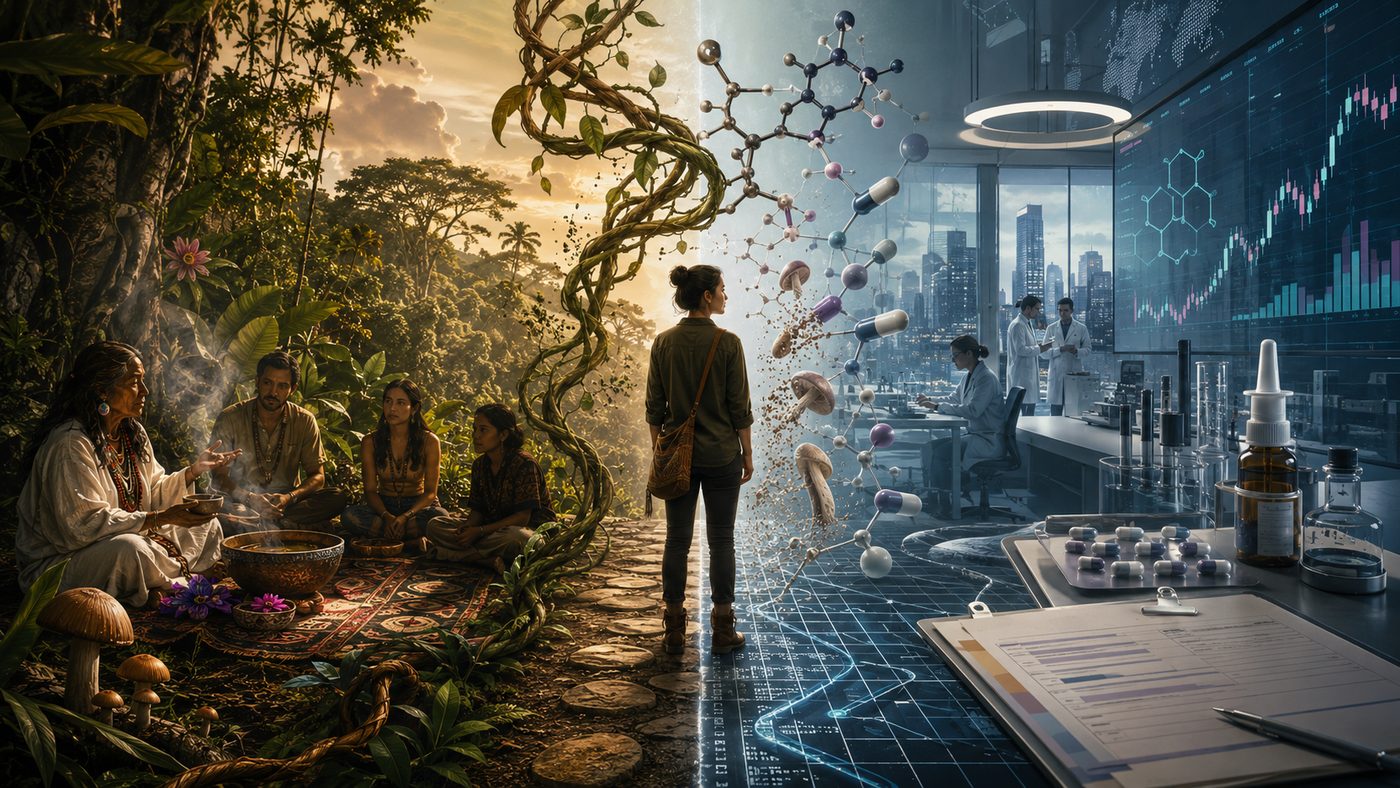
In three months, the field of psychedelic research and use acquired a strong political signal, a regulatory framework, and the largest amount of private capital in its history. People who spent decades calling for a more liberal approach to consciousness-altering substances now welcome the change and warn against it in the same breath. On one side, the conversation about psychedelics has an intensity it has never had before. On the other, a worry is surfacing: that mass production, patenting and medical standardisation will erase the culture of the people who devoted their lives to exploring altered states. The question is no longer whether psychedelics will become part of modern medicine. That process has begun. The question is what will be preserved along the way, and what will be lost.
What these substances actually are
The word “psychedelics” covers substances that produce marked changes in how we perceive reality, our own bodies, emotions, memories and the passage of time. The best known is LSD, which became one of the symbols of American hippie culture. Today ayahuasca is also widely known, a brew containing DMT that people, the author of this text included, travel to Latin America to drink. In techno and electronic music, MDMA, better known as ecstasy, found its audience. MDMA is usually classed as an entactogen rather than a classic psychedelic, though in therapeutic and regulatory debate it tends to be considered alongside them.
In the middle of the twentieth century these substances were the subject of serious scientific research. Their potential was studied in the treatment of addiction, anxiety, depression and other psychological difficulties. That momentum began to break, above all, after the American Controlled Substances Act of 1970. The restrictive turn was then locked in internationally by the UN Convention on Psychotropic Substances of 1971.
The research did not stop everywhere at once, though. In the 1950s and 1960s, Czechoslovakia was one of the important centres of psychedelic research. Stanislav Grof began his work with LSD here; Milan Hausner ran an extensive programme of LSD-assisted psychotherapy in Sadská; and the Czechoslovak firm Spofa manufactured the substance under the name Lysergamid. Among Slovak scientists, Juraj Styk is worth naming; after emigrating to Switzerland, he was one of a small number of therapists there with special permission to work with LSD and MDMA, and he continues to work with these substances to this day.
What the regulator actually said
The FDA guidance is interesting for two reasons.
The first is its dryness and its absence of ideological language. The agency states that psychedelic medicines get no special fast lane. Their development is subject to the same rules and the same standards of proof as any other drug. Chemistry, method of manufacture, preclinical safety, abuse potential and clinical-trial design will all be examined. In technocratic language, it says that after decades of political and cultural argument, it is time to start collecting trustworthy data.
The second is a methodological admission. Almost every psychedelic programme pairs the substance with psychological support. No one has yet measured precisely how much of the effect comes from the molecule and how much from the therapy that surrounds it. The FDA therefore asks sponsors to design studies capable of separating the two as cleanly as possible. It also wants them to examine the risk that therapists sense which participants received the active drug and which the placebo, and then, without meaning to, begin to treat them differently.
With psychedelic experiences, the tradition has always stressed the importance of “set,” a person’s inner disposition, and “setting,” the outer conditions: the environment, the light, the music, the felt sense of safety, the voice of the person guiding. The FDA is not claiming these influences cannot be studied scientifically. Quite the opposite. It asks researchers to design trials able to isolate and measure their effect.
An imbalance remains, all the same. A molecule can be weighed exactly, described chemically, standardised, patented and approved more easily than preparation, trust, or several hours of focused human attention. The regulatory system will therefore probably approve first the part of the treatment it can most easily measure. The accompaniment will be evaluated later, or paid for privately. Regulation can approve a molecule. It has a much harder time approving a relationship.
None of this is abstract, and it is closer than it looks. Compass Pathways, the most advanced company in the field, has two positive Phase III trials of synthetic psilocybin for treatment-resistant depression, has been granted a rolling review and one of the FDA’s new national priority vouchers, and expects to complete its submission by the end of 2026, with a possible launch in the first half of 2027, subject to approval and to rescheduling by the Drug Enforcement Administration. In practice, the first legally approved psilocybin medicine in the United States could be about a year away. And on 14 September 2026 the FDA will hold a public hearing on the therapeutic use of psychedelics devoted precisely to the questions the molecule cannot answer: how to train and credential providers, how to keep patients safe, how to handle access. The agency, in other words, is already building the scaffolding for the part it admits it cannot yet standardise.
Real money follows real business
With the Eli Lilly deal, the abstraction turns into concrete numbers. Lilly will pay 6.75 dollars a share in cash, roughly 2.8 billion dollars. To that it may add a contingent payment of up to 2.50 dollars a share if agreed development milestones are met. The total could approach 3.8 billion dollars, at a premium of around forty percent.
This is the largest transaction the psychedelic sector has ever seen, and Lilly’s first entry into the field. AtaiBeckley’s lead product is BPL-003, a synthetic nasal preparation containing 5-MeO-DMT for treatment-resistant depression. The company is also developing VLS-01, a DMT film absorbed through the lining of the mouth. AtaiBeckley is a clinical-stage biotechnology company with no approved product yet.
The detail worth pausing on is buried in the contract. Part of the contingent payment depends on whether the DEA moves the substance into a different regulatory category. Lilly has not bet only on the drug working. It has also bet that, within five to seven years, prohibition will be partly dismantled, and it has written that expectation into a binding financial instrument. When a company of this size starts treating prohibition as a quantifiable business risk, that is a signal prohibition’s days are numbered.
AtaiBeckley, moreover, did not begin as an ordinary pharmaceutical start-up. It is the product of a merger between Atai Life Sciences and Beckley Psytech, which grew out of decades of work by the British activist and researcher Amanda Feilding. She was among those who pushed for serious psychedelic research at a time when holding that position could cost a person their professional reputation. The counterculture was not defeated. It was acquired.
Meanwhile, in Prague
For readers outside central Europe, this is the part of the map that tends to go missing, and it is where the future is arriving fastest. Since 1 January 2026, Czech law permits the therapeutic administration of psilocybin, which makes the Czech Republic the first country in the European Union to build a nationwide legal framework for the medical use of the substance.
Psilocybin may be given for depression linked to an oncological illness, for clinically severe depressive disorder without psychotic symptoms, and, in exceptional cases, for the sudden worsening of another serious neuropsychiatric or mental disorder that threatens the patient’s life. The condition is that registered medicines have failed or that the patient has demonstrably not tolerated them.
A single dose may not exceed 0.4 milligrams per kilogram of body weight, nor a total of 35 milligrams. A dose above 25 milligrams may not be given at the first session. At most three administrations a month are allowed, at least seven days apart, with a total monthly ceiling of 75 milligrams. At lower doses the patient must be supervised for at least four hours; from 15 milligrams upward, supervision lasts at least six. Qualified professionals must be present, and integration psychotherapy should follow.
The Czech law is, to my mind, an example of careful, well-designed regulation. It is cautious, still narrowly drawn, and it keeps a professional in the room for the whole of the drug’s intense effect. The people defining today’s standards and protocols are taking care that the therapeutic use of psychedelics walks hand in hand with psychological support and with room to integrate the experience.
The Czech Republic is not starting from nothing. The Prague clinic Psyon has offered ketamine-assisted psychotherapy since December 2020, and a centre in Brno followed. In 2025, Germany authorised a compassionate-use programme giving patients with treatment-resistant depression access to psilocybin, permitted at two facilities, in Mannheim and Berlin. Switzerland has allowed psychedelic therapy under professional supervision since 2023. The updated European Medicines Agency guidance on the treatment of depression now formally includes this class of substances.
Legal permission, however, is not yet the same thing as available treatment. The practical rollout of the Czech system, and the way it will be reimbursed, remain open questions. If insurers pay for administering the substance but not for the hours of preparation, accompaniment and later integration, the new treatment will stay a privilege rather than standard care.
The Slovak context here is almost absurdly banal. With drug policies that barely register the developments of the past thirty years, we behave as though the whole subject has nothing to do with us. A press conference from the White House is a reminder that sometimes even the most unlikely tool goes off.
Demand for magic plants threatens their sources
For millennia, psychedelics were part of the rites and ceremonies of many cultures. They were mostly used in quantities that covered the needs of individual communities without endangering the future supply of the plants. Global demand upsets that balance.
The clearest example is peyote. This cactus grows very slowly and can be harvested only as fast as it grows back. Its wild populations, used by Indigenous communities for centuries in sacred ceremonies, are already under heavy pressure. The shortage has several causes: the destruction of natural habitat in south Texas and northern Mexico, poaching, unsustainable harvesting and rising demand. Among the contributing factors was the Western appetite for Indigenous spirituality, fed for decades by the books of Carlos Castaneda and later by the global psychedelic renaissance. Castaneda’s stories are today generally regarded as, at best, highly unreliable and largely invented. They were persuasive enough, all the same, to send thousands of people following in his footsteps and, in doing so, to endanger the very people he wrote about.
Paradoxically, the best protection for peyote may be laboratory-made mescaline. It could cover part of global demand and leave the wild cacti to their traditional users. That is possible only on one condition: that the patents which follow do not turn against the people who kept the whole body of knowledge alive for centuries. At least one model already exists. In December 2022, the company Journey Colab published the first pledge of its kind, promising not to enforce its mescaline patent against members of Indigenous communities who use it in traditional practice. That, in my view, is a practice worth following.
Ayahuasca is a harder case, because what is threatened is not only a plant but an entire protocol. In the traditions where its use developed, the place where the vine is harvested is treated as sacred and shielded from the presence of casual visitors. Gathering the plants, preparing them, storing them and consuming them all follow intricate rules. Without them, it is a different practice. The pharmaceutical framework has no adequate vocabulary for most of these relationships. And what a system cannot describe, it can only struggle to protect.
Iboga deserves a mention too, since ibogaine is the substance Trump’s order names explicitly. Iboga comes from the Bwiti traditions of Gabon, where even state efforts have failed to stop the illegal harvesting and smuggling of the root out of the country. Washington has just invested fifty million dollars in a molecule whose country of origin cannot protect its own supply.
An instrument for handling this already exists. The Nagoya Protocol, adopted in 2010 under the Convention on Biological Diversity, was created precisely so that the communities who steward genetic resources share in the benefits arising from their use. In the case of psychedelics, that principle is not yet being applied properly. It will need to be. In a world where the weight of international agreements is declining, that will not be easy.
Regulation protects tradition, it does not threaten it
Some people argue that traditional psychedelic use should be left to live its own life, with no regulation introduced at all. Peru shows why that approach fails.
In Iquitos, the saying goes that everyone is a shaman. Real curanderos are very few. Retreat centres are subject to no shared, mandatory safety protocols. Some take a medical history from their clients. Many do not. Consistent standards across the industry barely exist.
The consequences are documented. In 2018, a Canadian visitor, Sebastian Woodroffe, shot dead an elder healer, Olivia Arévalo, of the Shipibo-Konibo. The anthropologist Emily Sinclair later wrote that, according to her sources in Iquitos, he had previously been refused entry to ayahuasca ceremonies in Canada because of his psychological instability. Shortly after the killing, a crowd of locals killed Woodroffe.
The case became more than a warning about inadequate screening of participants. It also showed how quickly a failure of safety can turn into further violence and collective trauma. In January 2025, the U.S. embassy in Peru issued a health warning after several American citizens died or suffered serious harm. According to Peruvian media, in early June 2025 an American visitor died of multiple organ failure in the Loreto region after an ayahuasca ceremony. Reports stated he had been taking antibiotics, which he probably did not disclose to the organisers. These are exactly the cases that show why a medical history is not a bureaucratic ornament but a basic part of safety.
The danger to traditional practice is not regulation. It is unregulated expansion. The inflow of foreign clients and capital has created a crowd of centres that trade on the reputation of Indigenous traditions without bringing proportionate benefit to local communities.
Some operations neglect health screening and safety protocols. Others do employ experienced healers from Shipibo communities, but pay them poorly and offer them no basic job security. The problem, then, is not only frauds and charlatans. It is also an industry in which a significant part of the value comes from Indigenous knowledge, while the profit flows elsewhere.
When the naming itself does harm
Language, too, is part of the problem. The organisation ASOMASHK, formed as a direct response to the tragedy surrounding Olivia Arévalo, brings together traditional healers of the Shipibo-Konibo-Xetebo people, who call themselves by the word onanya, in the plural onanyabo. They reject the terms “shaman” and “shamanism” as imported labels that distort the particular character of their medicine and that have, in the past, served to mock and belittle it.
A system that wants to protect traditional knowledge might begin by learning what its bearers call themselves. ASOMASHK was founded after a gathering of traditional healers in Yarinacocha in 2018, where they adopted the Declaration of Yarinacocha. In July 2024, more than a hundred onanyabo gathered there again. They discussed the growing spiritual tourism, the economic exploitation of traditional healers, and the over-harvesting of the plants Banisteriopsis caapi and Psychotria viridis, from which ayahuasca is prepared.
The organisation’s president is Walter Ramiro López, also known as Panshin Nima. As it happens, he is the brother of the late Roger López, with whom I completed my own dieta. His objection to the current course of events is not only spiritual or symbolic. It is economic. Foreign entrepreneurs open centres, hire masters from Shipibo communities, pay them low wages, and provide them no adequate social or labour protection. The Western world can thus take from the tradition its active compound, its protocol, its labour and its authority, while the people who sustained it across generations are left with the least.
We already have the vocabulary
At the international level, psychedelics fall under the 1971 Convention on Psychotropic Substances. Changing it requires a recommendation from the World Health Organization and a vote of the fifty-three-member UN Commission on Narcotic Drugs. A genuine review of the basic logic of these treaties has never begun. Yet we do not need to invent a new vocabulary.
The Global Commission on Drug Policy, an independent body made up of former presidents, ministers and UN officials, concluded years ago that the international drug-control regime does not work. Its members have included Kofi Annan, Fernando Henrique Cardoso, Ruth Dreifuss and Helen Clark. The Commission called for an end to the criminalisation of drug use and possession and for their responsible legal regulation. The recommendations are written. They remain unfulfilled.
One member of that Commission is Pavel Bém, a former ODS politician and mayor of Prague. In January 2026, the Czech government appointed him national drug-policy coordinator. He lasted until the end of June. He learned of his dismissal from a text message during his holiday.
Formally, it was a reorganisation of the portfolio. The prime minister, however, explained it openly as a shift toward a more prohibitionist approach, saying he did not want a “pro-drug” coordinator and noting that the police anti-drug directorate was delighted with the change. Bém, who in the 1990s had helped move drug policy to the government office in the first place, called the reorganisation unwise and warned that the country is not prepared for a fentanyl crisis. So in the course of the same year, the Czech Republic became the first EU country with a nationwide legal framework for psilocybin therapy and, at the same time, ended the work of the person best professionally equipped to steer such changes.
Three conditions for a psychedelic renaissance
The psychedelic renaissance faces enormous challenges. Substances that dramatically alter our perception of the world once frightened politicians enough to push them to the margins of science for whole decades. Today’s leaders of this movement have, in essence, three things to secure.
First, the basis for change has to be evidence gathered by scientific methods. Superstition, ideology and personal conviction must be separated from data that can be verified. Psychedelics must be held to the same standards of safety and efficacy as any other substance studied for therapeutic use.
Second, political and legislative change has to take account of the grey zones and the long illegality of psychedelic practice. Alongside expensive stays and sessions in certified centres, there must be room, for instance, to integrate the experience of people who, on an autumn walk in the Carpathians, gently overdid it with a handful of liberty caps. If psychedelic practice becomes a business sector that brings tax revenue into public budgets, part of those funds should go toward reducing harm, including for the people who stay loyal to the old, well-worn paths.
Third, the traditional use of psychedelics in Indigenous communities must not become a casualty of their sudden popularity. The aim has to be a joining of scientific, anthropological and cultural knowledge in a way that lets understanding transfer safely, without endangering original practices, natural resources, or the economic standing of the communities that kept them alive.
An evidence-based approach and cultural sensitivity are not opposing demands. The people who have worked with these plants for centuries developed their protocols for the same reason the FDA and other regulators write theirs. Without rules, people get hurt. After decades of senseless restriction on the research and use of these substances, we in the Western world have a chance to sit the exam again.
One last thought, and a piece of homework. If you want to understand where this is heading, spend an evening not with the news but with Timothy Leary. I wrote about his Info-Psychology in my previous post, and rereading him in 2026 is a strange experience: the re-imprinting of the brain, the merging of mind and machine, intelligence as the lever that moves everything else. We are watching artificial intelligence very closely, and rightly so. The psychedelic renaissance deserves the same attention, and the two stories are closer than they look. Both are, at bottom, about what a human being is for, and who gets to decide.
Let’s try, this time, to do it right.