ChatGPT and Your Brain: Cutting Through Cognitive Debt Hype
Beyond the Viral Headlines: What’s Really Happening?
Lately, headlines have sounded the alarm about “Your Brain on ChatGPT” – claiming that using AI like ChatGPT puts us in “cognitive debt,” makes our brains lazy, or even leads to “cognitive bankruptcy.” These buzzwords came from an MIT study that indeed found people’s brains work less when they lean heavily on ChatGPT for tasks. It’s a dramatic finding. But before we all swear off AI, let’s take a skeptical look at what this and other research actually say. Is ChatGPT really making us dumber, or is it more about how we use it? And could it even make us smarter when used right?
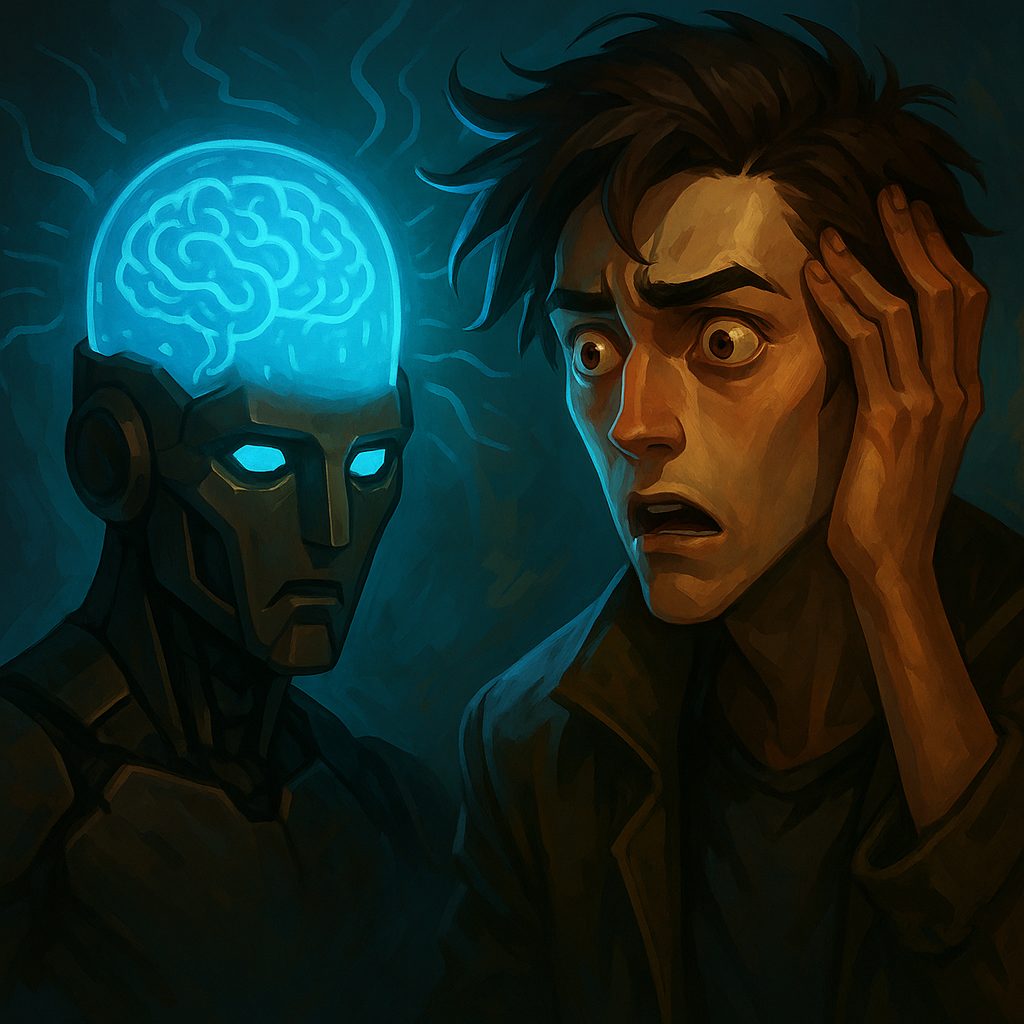
Image created using ChatGPT 4o
To answer that, we’ll contrast the MIT EEG study (which monitored students’ brain activity as they wrote essays with or without AI help) with a new meta-analysis by Wang & Fan (2025) that pooled 51 studies on ChatGPT in education. We’ll also explain concepts like cognitive offloading (letting a tool carry some mental load), metacognitive laziness (getting too lazy to think about our own thinking), and guided scaffolding (structured support that helps us learn). The core message? The problem isn’t using AI – it’s using AI passively**.** As we’ll see, research suggests active engagement with tools like ChatGPT can boost learning, whereas blind reliance might come at a cost.
Cognitive Offloading vs. “Cognitive Debt” – A Double-Edged Sword
The MIT Media Lab study put the spotlight on cognitive offloading, which is basically delegating mental work to an external helper (in this case, ChatGPT). Think of it like relying on a GPS for navigation: the GPS does the heavy lifting of figuring out the route, so your brain doesn’t have to. This can be great – you free up mental energy for other things – but there’s a catch. If you always offload without engaging, you might not form a strong internal map of the territory. In the MIT experiment, students who offloaded essay writing to ChatGPT had the “weakest neural coupling” – their EEG readings showed less widespread brain activity than students who wrote essays unaided or even those using a normal search engine. In interviews, over 80% of those AI-assisted students couldn’t accurately recall a quote from the essay they just wrote (or rather, that the AI wrote). Ouch. The researchers dubbed this effect “cognitive debt,” suggesting that by shortcutting hard thinking upfront, those students “borrowed” mental effort they didn’t repay – ending up with shakier learning and memory.
But does using AI inevitably put you in “cognitive debt”? Not if you use it the right way. Offloading some tasks is not new – we’ve used paper, calculators, and Google for years to handle routine stuff. It’s all about balance. For example, using a calculator for arithmetic can be smart cognitive offloading, if you still understand the math concept; but if you rely on it for 2+2, you might forget how to do basic addition. Offloading too much can make our mental skills atrophy, much as relying on GPS made some of us lose our sense of direction. Throughout history, thinkers from Plato to Thoreau warned that over-reliance on new tools might erode our own abilities. However, it’s not about shunning tools like AI, but learning to use them without losing our own mental muscles. In other words, use the GPS, but occasionally look out the window and learn the road. And, when you have the time, wander around the town, get lost on purpose and then get to a place you know using only visual anchoring points.
So yes, the MIT study’s participants who treated ChatGPT like an autopilot – letting it do most of the work – showed less brain engagement and weaker recall. But does that mean ChatGPT itself is to blame? Or could it be the way those students used it? Here’s where we should be careful about bombastic conclusions. The study’s authors themselves cautioned that their sample was small and the scenario artificial (a 20-minute timed essay). Crucially, they noted it’s unclear how things might differ if students used the AI more reflectively or interactively rather than mostly copy-pasting text. In fact, when some students in the experiment switched to using the AI after first learning to write without it (“brain-to-LLM”), their brains showed a spike in activity – integrating AI suggestions required extra mental work to align with their own ideas. That’s the opposite of mental laziness. It hints that using AI can be an engaging challenge if you approach it that way. So the scary “cognitive debt” narrative only tells half the story: the passive use of AI is the real culprit, not AI use per se.
Metacognitive Laziness: When We Stop Checking Ourselves
Another concept swirling around this topic is metacognitive laziness – basically, getting lazy about thinking about your own thinking. A metacognitively active student might, for example, pause to ask “Do I really understand this answer ChatGPT gave me? Could it be wrong or incomplete?” A lazy one just accepts the answer and moves on. In the MIT study, some AI-using students fell into the latter camp: they tended to accept the bot’s suggestions without much critical thought, leading to essays that human graders described as generic and “soulless”. This is like trusting the GPS blindly – you stop paying attention to whether the route makes sense. Most of us have heard stories of drivers following navigation into lakes or dead-ends because they weren’t mentally engaged. Similarly, when we treat ChatGPT as an infallible oracle, we risk turning off our inner monitor that asks, “Does this actually make sense?”
It’s easy to slip into metacognitive laziness because AI outputs sound confident. This is called automation bias – our tendency to trust a slick automated solution too much. I’ll admit, I’ve caught myself doing this: if ChatGPT’s answer is polished, I’m tempted to take it as-is. But studies (and a healthy dose of common sense) suggest we should resist that pull. Recent decades give us a vivid warning that even highly skilled professionals have lost their edge by over-trusting automation; pilots have forgotten how to fly manually, doctors have missed diagnoses by over-relying on AI, etc.. The antidote is to stay in the loop. We need to treat the AI like a colleague or a student: question it, double-check it, even ask it to justify itself. By doing so, you turn usage into a mental workout rather than a mental nap.
A great analogy here is staying in the pilot’s seat. Yes, modern planes have autopilot, but good pilots don’t nap through the flight – they monitor, ready to take control if needed. Likewise, an AI like ChatGPT can be an amazing co-pilot for your mind, catching errors and suggesting ideas, as long as you remain the captain. If you abdicate all control, you’re essentially letting a robot fly your plane while you doze off – and that’s when you get into trouble. The key is what one might call active offloading instead of lazy offloading. You let the AI handle some tasks, but you actively guide the process: ask follow-up questions, feed it better prompts, verify the answers. In short, keep your hands on the steering wheel (or at least hover them nearby)!
Guided Scaffolding: How ChatGPT Can Boost Learning
Now for the good news: when used wisely, ChatGPT doesn’t drain brains – it trains brains. The meta-analysis by Wang & Fan (2025) looked at dozens of studies on using ChatGPT in education, and found a large positive overall effect on students’ learning performance, plus moderate improvements in their perceived learning and higher-order thinking skills. In plain English: students using ChatGPT (in the right ways) tended to learn more, feel more engaged, and even improve skills like analysis and critical thinking, compared to those who didn’t use the AI. How is that possible, given the MIT results? The answer lies in how the AI was integrated. The studies that showed benefits usually didn’t have students just copy-paste an essay from ChatGPT. Rather, they used ChatGPT as a tutor, a brainstorming partner, or a tool for feedback. The meta-analysis found that ChatGPT was most effective when paired with appropriate scaffolds or educational frameworks – for example, having students follow Bloom’s taxonomy (moving from basic questions to deeper analysis) when prompting the AI. In essence, the AI was a guide on the side, not a brain-replacement. This guided use pushed students to think with the AI. It’s akin to training wheels on a bike: the wheels (AI) provide support, but the child still has to pedal and steer, building the skills to eventually ride on their own.
Let’s illustrate guided scaffolding with an analogy. Imagine you’re learning to solve math problems. A bad way to use an AI would be to just ask it for the answers – you get solutions with zero understanding (that’s like copying someone’s homework). But a guided way might be: you attempt the problem, then ask the AI for a hint or to explain the next step. Or you ask it to check your reasoning. You’re still doing the cognitive work, but with an ever-available coach. One of the meta-analysis’s recommendations was to use ChatGPT as an “intelligent tutor” or learning partner in exactly this fashion. Over a 4-8 week period of such use, students saw significantly better outcomes than classes without AI. This suggests that far from making students lazy, a well-implemented AI can encourage more active learning – because students can get instant feedback, explore “what if” questions, and engage in dialogue, rather than passively reading a textbook.
Crucially, though, the AI works best when students stay active. If they treat ChatGPT as a magic answer box, they learn less (or even risk the cognitive debt issues). But when teachers set up structure – say, requiring students to ask the AI thoughtful questions, to compare its answers with their own, or to debate the AI’s response – the students’ higher-order thinking skills get a boost. Prompting becomes powerful when treated as structured thinking — not as technical trickery. In other words, you shouldn’t just type random questions and hope the AI spits genius. You guide it step by step, break problems into sub-tasks, and basically think out loud through your prompts. One tip: prompt like a chef, not a microwave user. A chef carefully selects ingredients, tastes and adjusts seasoning; a microwave user just presses a button and waits. In an AI context, this means iteratively refining your prompts and responses (the tasting and adjusting) rather than expecting a perfect essay from one go (microwaving). Such structured prompting ensures you remain mentally present and learning from the AI, rather than just consuming whatever it serves.
Collaborative Fluency: Man and Machine, Better Together
Perhaps the most exciting idea here is what I call collaborative fluency – basically, becoming fluent at working together with AI. Just as digital literacy was about knowing how to use computers and the internet, collaborative fluency is about knowing how to optimally team up with AI to amplify your capabilities. Instead of viewing ChatGPT as either a menace or a crutch, this perspective treats it as a partner. A partner, by the way, can challenge you – the best use of AI often involves having it question your assumptions or provide a counterpoint, not just do your work. For example, you can ask ChatGPT to play devil’s advocate on your opinion, forcing you to strengthen your argument. You can ask it to explain a concept back to you and check if that matches your understanding. All these are active uses that spur your thinking. In a very real sense, you and the AI each bring something to the table: the AI brings breadth of information and rapid analysis; you bring judgment, context, and creativity. When combined, if done mindfully, you get results better than either could alone. The goal is a synergy where AI’s computational power and speed combine with human creativity and judgment to achieve results better than either could alone. That’s the promise of collaborative fluency – but it only materializes if both sides are actively contributing.
The MIT study’s gloomy scenario was one where the human contribution shrank (the students let the AI lead), breaking the partnership dynamic. The meta-analysis’s bright results show the opposite: when humans stay in charge and actively use the AI as a tool or teammate, both the performance and the learning shot up.
So, the problem isn’t that ChatGPT will inherently rot your brain – it’s that it can if you treat it as a replacement for thinking. The flip side is also true: ChatGPT can sharpen your mind if you use it as an aide. It’s a bit like having an expert friend who knows tons of stuff – if you just parrot whatever your friend says, you learn nothing; but if you engage them in discussion, ask them to clarify, and compare it with what you know, you’ll both come out smarter.\
Try this thought experiment: take any recent headline about the MIT study and replace “ChatGPT” with “Bible.” “ChatGPT may be eroding critical thinking” becomes “The Bible may be eroding critical thinking.” Sounds strange — maybe even absurd. Why? Because we instinctively know that a book isn’t to blame for how someone reads it. Yet the same logic applies to AI. ChatGPT, like the Bible, doesn’t carry fixed meaning — it reflects the mindset of whoever engages with it. A dogmatic preacher and a curious scientist can present the same scripture in radically different ways. Similarly, what you get from ChatGPT depends on what you ask and how you think. It’s not the tool that makes us wise or foolish — it’s the posture we bring into the conversation. AI just amplifies it.
How to Stay in the Driver’s Seat: Practical Takeaways
Let’s get practical. How can we ordinary users avoid the trap of AI-induced mental atrophy and instead harness AI for good? Here are a few research-backed tips for engaging AI critically and actively:
-
Mix your own thinking with the AI’s. Don’t ask ChatGPT to do your entire task outright. Try an approach like: do part of it yourself first, then ask the AI for help on a specific piece, or to critique/improve what you have. This keeps you in the loop and prevents the “lazy brain” syndrome from the start.
-
Always verify and reflect. Treat any AI output as a first draft or an idea, not the final answer. Ask yourself: “Does this answer make sense? How would I explain it in my own words?” If something sounds off, dig deeper. By summarizing the AI’s answer in your own words or fact-checking its claims, you force your brain to process the material, combating shallow recall. Remember, the MIT students who couldn’t remember the AI-written essays hadn’t truly internalized the content. Internalization comes from reflection and re-articulation.
-
Use AI as a sparring partner, not just an answer genie. For example, prompt the model you use to ask you questions (“Quiz me on this topic”) or to debate you. If you wrote an essay with AI, try defending it to the AI: “Critique the argument I just presented.” This turns on your metacognitive gears – you’re thinking about your thinking. Studies suggest this kind of active back-and-forth leads to deeper learning than one-shot Q&A. It’s like turning the passive GPS into a live navigation class where you explain each turn as you take it.
-
Apply structure or frameworks in your prompts. A concrete tip from education research is to use established frameworks like Bloom’s taxonomy: ask a factual question first, then a conceptual why/how question, then an analytical question. This ensures you’re scaffolding the interaction towards higher-order thinking. Similarly, you can prompt step-by-step: “First, let’s outline the problem… now, let’s examine one part… now, let’s consider an alternative,” etc. The AI will follow your lead – and by leading, you stay mentally engaged. Structured prompting = structured thinking.
-
Stay curious and in charge. Approach ChatGPT with a mindset of collaboration and even play. If it gives an answer, you might follow up with “Can you explain that with an analogy?” or “What’s a counterpoint to this?” – not because you couldn’t think of any, but to explore angles. Curiosity keeps your brain active. Also, don’t be afraid to override the AI. If its suggestion doesn’t feel right, trust your judgment and use the AI as a tool to refine your idea, not to substitute it. In other words, maintain that captain’s seat position – AI is the co-pilot.
By following these practices, using ChatGPT becomes less like riding a moving walkway (where you stand still and let it carry you), and more like riding a bicycle with gears – you still pedal, but the gears (AI) help you go further or faster. The research consensus is heading toward this balanced view. As Wang & Fan (2025) concluded, students benefit most when ChatGPT is “actively integrated” into learning as a partner or tutor, not when it’s an automation crutch. And as the MIT team implied, uncritical early dependence on AI can dull your skills, but thoughtful use might avoid those pitfalls.
Conclusion: No, AI Won’t “Fry” Your Brain – Unless You Let It
It’s tempting to either panic about AI ruining our minds or, conversely, to embrace it as a magic fix for all learning. The truth, as usual, is more nuanced and frankly more interesting. Yes, there’s genuine evidence that using ChatGPT naively (to cheat through work or avoid thinking) can lead to shallower learning – your brain on autopilot, as the MIT authors showed with those EEG scans. But there’s also strong evidence that using ChatGPT actively and intelligently can improve learning and even critical thinking. It’s a bit like the difference between mindlessly binge-watching educational videos versus taking an interactive course – one is passive intake, the other is engaged learning, even if both use technology.
Ultimately, the cognitive effect of ChatGPT comes down to metacognition and agency. Are you staying aware of how you’re using it? Are you the pilot or just a passenger? The hype about “cognitive debt” isn’t entirely unfounded – it’s a real risk if students or AI usewrs simply outsource their brains to AI. But the solution isn’t to stigmatise AI itself, but to teach and encourage better use of it. As the notion of collaborative fluency highlights, our goal should be to become fluent partners with AI, not dependent drones. That means developing the habits and skills to leverage AI as a powerful extension of our thinking, while keeping our own cognitive gears turning.
So next time you see a headline about AI making us stupid, remember: the research shows AI can also make us smarter – it all hinges on whether we use it lazily or actively. The real message from all this? Don’t fear the chatbot; just don’t forget to bring your brain to the conversation.
References:
-
Kosmyna, N. et al. (2025). “Your Brain on ChatGPT: Accumulation of Cognitive Debt when Using an AI Assistant for Essay Writing Task.” Preprint. MIT Media Lab. (arXiv link)
-
Wang, J. & Fan, W. (2025). “The effect of ChatGPT on students’ learning performance, learning perception, and higher-order thinking: insights from a meta-analysis.” Humanit. Soc. Sci. Commun. 12, 621. (Journal link)