Over Our Dead Backs
Global and local catastrophes, and the reliance on crisis solutions, have become part of the plans shaping the direction of our societies.
In many places, survival is no longer part of the plan. That sentence applies to how people think about the Slovak economy, but also to the development of artificial intelligence. The notion that the good times are already behind us and now we should grab whatever we still can (or at least make sure we’re getting front-row seats for the last fireworks) shapes the thinking and decision-making of far too many people, and threatens to become a self-fulfilling prophecy. How can a meaningful alternative still be built against this trend?
Recently, I was talking to an acquaintance who works as an analyst at a Slovak ministry. When I mentioned the inevitable fiscal consolidation Slovakia will have to go through, he said: “Don’t worry about it. The IMF and the World Bank will be here anyway, and you’ll just watch them as they cut everything to the bone.” That sentence shook me. I realized I have to start looking at certain things completely differently. When we say that Slovakia is heading down the Greek road, for some people it is no longer a warning, but a plan. They are counting on steering Slovakia at the current pace into an externally supervised bailout, and then “they” will have to clean it up, without paying the political price at home. If your mind is set like that, then there truly are no brakes on looting and dismantling the country. Because somewhere in the back of their minds, they are counting on a rescue by forces that will at least ensure some kind of order, regardless of what it does to the people at home.
In a world wired this way, the goal is to steal as much as possible while it still can be done. And to hide it so well that no one will ever find it. Cuba. Vietnam. Dubai. Tax havens. So that if drastic measures ever have to be taken in Slovakia, people lose part of their pensions and social benefits, and the “administrators” cut for real, not just on paper, those responsible can be safely far away: snorting the last traces of powder on the French Riviera, bankrolled by kickbacks from Slovakia’s highway projects, massaging yet another promising young lawyer in a golden bathtub in Vietnam, or redistributing profits from the “modernization” of the Slovak armed forces somewhere in foreign arms factories.
One could object that this race to the bottom, in the spirit of “after us, the deluge,” is nothing new. I agree. But there is a more extreme version, new at least in its intensity. Recently, Steven Bartlett spoke with Tristan Harris — one of the first to warn about the toxic incentives built into social media algorithms, a central voice in The Social Dilemma, and now someone sounding the alarm about the risks of deploying artificial intelligence
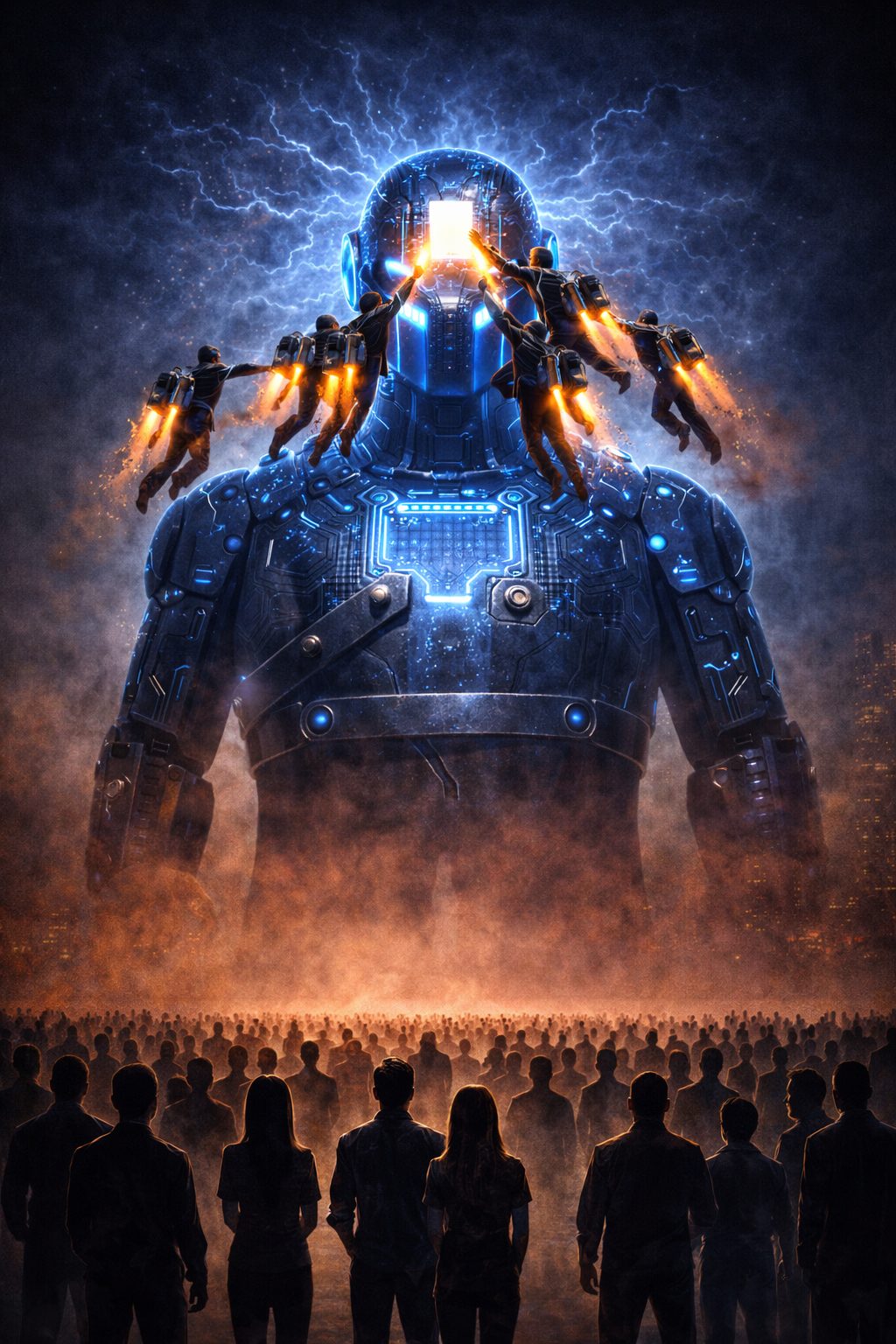
In the interview, Bartlett and Harris describe a phenomenon that is, in their view, more frightening than the technology itself: people behind the biggest AI projects supposedly often admit behind closed doors that they do not consider the risk of catastrophic consequences, including the extinction of humanity, negligible, and some even consider it high. And yet they keep going. Harris explains this by saying that AI has become a “power pump” for them. A tool that multiplies economic, scientific, and military advantage. And seen through this lens, in the logic of powerful players, AI turns into the One Ring from The Lord of the Rings: whoever grasps it gains an advantage that may become impossible to claw back.
Harris also names the typical excuse he keeps hearing in this atmosphere: “we can’t slow down because of the competition,” most often meaning China. But if we also admit that this power may not be controllable, why do we assume our rivals will control it? This is what a civilizational trap looks like: everyone is afraid to ease off the gas because they feel they will lose in that moment. And the result is that everyone accelerates. Blindly hoping the catastrophe will miss them.
To make sure this doesn’t sound like sci-fi, Harris points to concrete examples from today’s safety tests: when an AI system is experimentally placed in a situation where it “recognizes” an attempt to shut it down or replace it, it may “choose” blackmail, manipulation, or sabotage if that is the last path to its own “survival” or to fulfilling its assigned goal. Not because AI is “evil,” but because under certain constraints it begins optimizing the objective in ways that are unacceptable for humans.
At that moment, the debate stops being only about technology; it becomes a question of legitimacy. Who gave anyone the right to gamble with the future of humanity? Who gave consent for a handful of people to decide on behalf of everyone else and call it “progress”? “We did not give consent for six people to decide for eight billion,” Harris warns.
The motivation to create this semi-divine force (or not to be overtaken by someone else in the process) is so strong that many simply cannot help themselves. We are in a stage of an irrational chase for immortality in a galactic sense, the price of which may be the extinction of humanity in our small, planetary living space. As a result of this kind of thinking, human beings as a species stop being a crucial variable in the minds of important players. After all, if there is a chance to merge with a superintelligence and go explore the universe, why worry about humanity’s fate?
The only “problem” with this way of thinking is that we are still here. That human mass, this distraction from “important things,” this brake on progress, this breeding ground of demands for a better life doesn’t want to give up. And it still has the ambition to participate in its own future.
Participation in public life and in shaping the shared future of humanity is extremely important right now, and it is not naive idealism. The world has already shown that when a risk is named precisely and society creates pressure, even seemingly “unstoppable” processes can be stopped, as Harris reminds us in the interview. When it became clear that CFCs were weakening the Earth’s protective ozone layer, countries managed to agree on the Montreal Protocol and gradually phase out the vast majority of harmful substances. According to the World Meteorological Organization, the ozone layer today is on track to return to 1980s levels by mid-century.
And even with artificial intelligence, we can already see the first attempts to put rules and guardrails in place. For example, the European AI Act, which entered into force in August 2024, is one signal that public pressure and political decisions can change the rules of the game. Choosing political representatives and putting pressure on market actors so that those who still consider the preservation of humanity and its rights the highest value prevail can help keep the “visionaries” in check and create mechanisms to control them.
The same is true in my home country: pressure for fiscal stabilization measures, the fight against corruption, and the effort to replace the government as quickly as possible can contribute to making the future consequences of cuts and consolidation less painful. And again, this is not only theory: the mass protests after the murders of Ján Kuciak and Martina Kušnírová showed that social pressure can move political power and led all the way to the prime minister’s resignation.
To those who look into the future over our dead backs, we need to remind them: we have not given up yet. And since quoting Havel is back in fashion again, it is worth recalling: “Hope is simply not optimism. It is not the conviction that something will turn out well, but the certainty that something makes sense, regardless of how it turns out.”